Record 027 · Other · n.d.
Decoding the ANA: A Guide to ANA Testing
University of North Carolina Division of Rheumatology, Allergy, and Immunology · requested inclusion
“Clinician-facing UNC rheumatology guide on when to order ANA, how to counsel patients, titer interpretation, and why serial ANA is not useful for disease activity. Explicitly states a positive ANA alone does not diagnose autoimmune disease.”
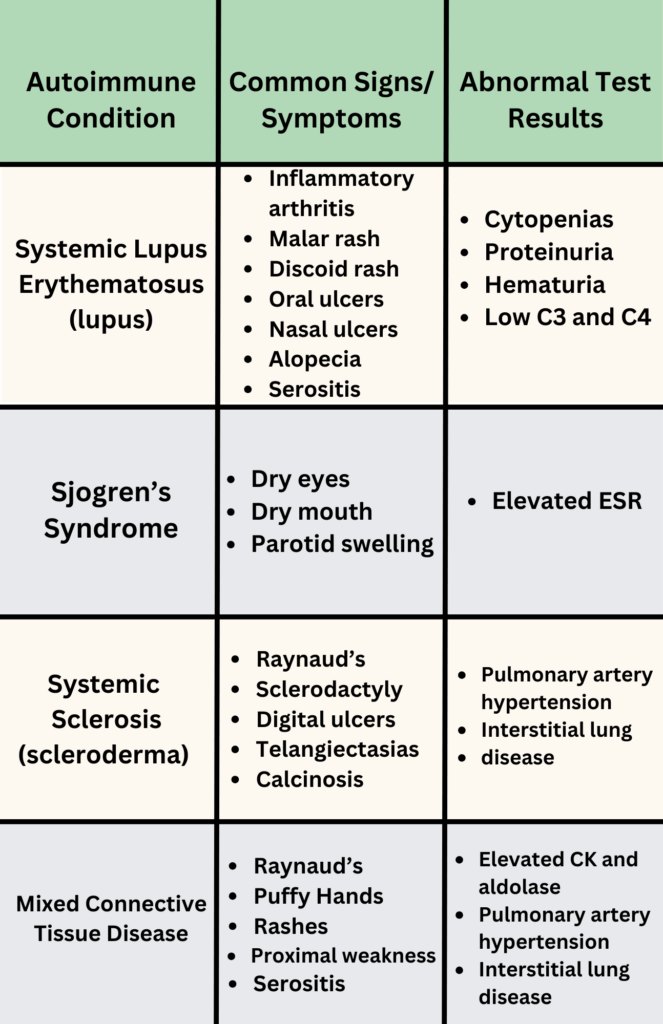
Clinician-facing UNC rheumatology guide on when to order ANA, how to counsel patients, titer interpretation, and why serial ANA is not useful for disease activity. Explicitly states a positive ANA alone does not diagnose autoimmune disease. Candidate notes: Order ANA only with high suspicion for diseases such as Sjogren, lupus, or scleroderma—not for fatigue, back pain, headaches, diffuse pain, or vague symptoms alone. Do not repeat a positive or negative ANA; serial ANA is not useful to monitor disease activity because ANA usually remains positive even when disease is controlled. Positive ANA can be seen in up to 20% of healthy adults; up to 30% of healthy individuals may be positive at 1:40 or greater. Higher titers are more likely clinically significant; one cited study reported median titer 1:320 in confirmed autoimmune disease. If lupus is strongly suspected after positive ANA, consider CBC, CMP, UA/protein ratio, dsDNA, ENA, and C3/C4. Order ENA only if ANA is positive AND autoimmune disease is suspected; UNC ENA panel includes Sm, RNP, SSA, SSB, Jo-1, Scl-70. Patients with positive ANA but no autoimmune symptoms do not need rheumatology referral solely for the ANA. Limits noted in the record: Educational institutional guidance citing secondary literature; not a formal society guideline. A positive ANA is not a diagnosis. Claims in this record are not verified.
A positive ANA is not a diagnosis. Claims in this record are not verified.
source
- ANA_titer
- clinical_utility
- false_positives
- follow_up_tests
- interpretation
- negative_result
- positive_result
- serial_ANA_disease_activity
Other