Prev: High concomitance of disease marker autoantibodies in anti-DFS70/LEDGF autoantibody-positive patients with autoimmune rheumatic diseaseNext: Longitudinal anti-nuclear antibody (ANA) seroconversion in systemic lupus erythematosus: a prospective study of Swedish cases with recent-onset disease
Record 037 · Research · 2020
Increasing Prevalence of Antinuclear Antibodies in the United States
Arthritis & Rheumatology · requested inclusion
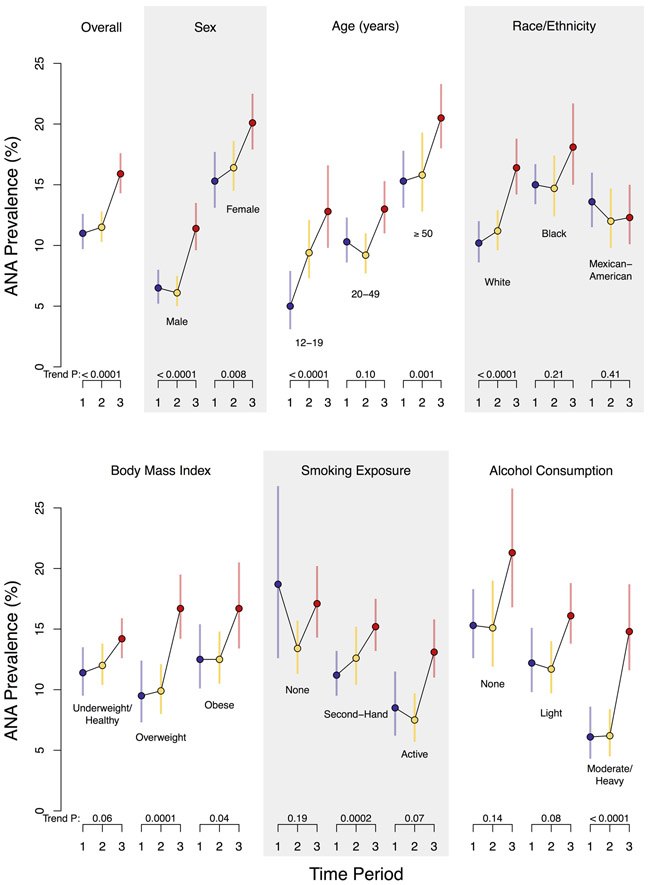
“NHANES-based study of 14,211 US participants age 12 and older across three time periods (1988-1991, 1999-2004, 2011-2012) found ANA prevalence rose from 11.0% to 11.5% to 15.9%, corresponding to about 41 million ANA-positive Americans in 2011-2012.”
NHANES-based study of 14,211 US participants age 12 and older across three time periods (1988-1991, 1999-2004, 2011-2012) found ANA prevalence rose from 11.0% to 11.5% to 15.9%, corresponding to about 41 million ANA-positive Americans in 2011-2012. Candidate notes: ANA prevalence 11.0% (1988-1991), 11.5% (1999-2004), 15.9% (2011-2012), P for trend <0.0001 Adolescents age 12-19: odds ratios 2.02 and 2.88 vs first period; sharpest increases also in men, adults 50+, and non-Hispanic whites ~22 million, ~27 million, ~41 million affected individuals in the three periods Limits noted in the record: Cross-sectional survey design at each time point: associations reported, not causal claims Increases not explained by concurrent measured trends in obesity, smoking exposure, or alcohol consumption A positive ANA is not a diagnosis. Claims in this record are not verified.
A positive ANA is not a diagnosis. Claims in this record are not verified.
source
- change-over-time
- healthy-people
- positive-ana
Research
Also in this file
View all in file Antinuclear antibody-negative systemic lupus erythematosus: How many patients and how to identify?22.34.E · Archives of Rheumatology
 Clinical diagnoses associated with a positive antinuclear antibody test in patients with and without autoimmune disease23.35.E · BMC Rheumatology
 High concomitance of disease marker autoantibodies in anti-DFS70/LEDGF autoantibody-positive patients with autoimmune rheumatic disease08.36.E · Lupus
 Longitudinal anti-nuclear antibody (ANA) seroconversion in systemic lupus erythematosus: a prospective study of Swedish cases with recent-onset disease19.38.E · Clinical and Experimental Immunology