Prev: Longitudinal anti-nuclear antibody (ANA) seroconversion in systemic lupus erythematosus: a prospective study of Swedish cases with recent-onset diseaseNext: Measurement of antinuclear antibodies: assessment of different test systems
Record 039 · Research · 2024
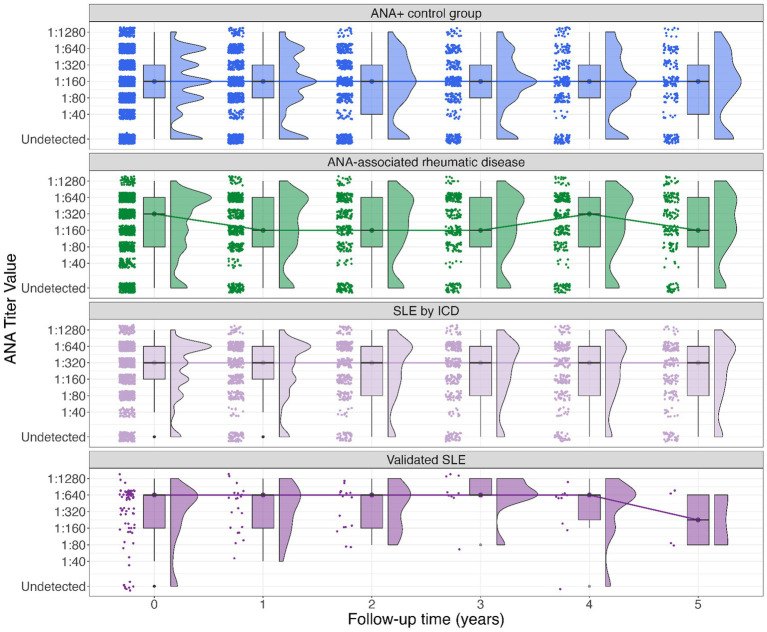
Longitudinal antinuclear antibody titers in systemic lupus erythematosus and other rheumatic diseases
Frontiers in Medicine · requested inclusion
“Retrospective EHR analysis (1999-2020) of 6,983 patients with 2 or more ANA-IFA tests found SLE patients had higher odds of positive ANA and higher titer strength than other rheumatic-disease patients or ANA-positive controls, but titer strength decreased over time in all groups.”
Retrospective EHR analysis (1999-2020) of 6,983 patients with 2 or more ANA-IFA tests found SLE patients had higher odds of positive ANA and higher titer strength than other rheumatic-disease patients or ANA-positive controls, but titer strength decreased over time in all groups. Candidate notes: SLE vs other ANA-associated rheumatic diseases: OR 2.10 (95% CI 1.82-2.43) for positive ANA, adjusted for time and demographics Titer strength decreased 0.001-0.004 log titer units/month from first positive ANA in all groups (p<=0.001) 183/1516 (12.1%) of SLE patients had a subsequent negative ANA Limits noted in the record: Retrospective, exploratory EHR analysis; ANA tests were ordered for clinical care, introducing testing-indication bias Median only 2 ANA assessments per patient with average 27-month follow-up; validated SLE cohort was small (n=71) A positive ANA is not a diagnosis. Claims in this record are not verified.
A positive ANA is not a diagnosis. Claims in this record are not verified.
source
- change-over-time
- disease-activity
- negative-ana
- positive-ana
- systemic lupus erythematosus
- titer
Research
Also in this file
View all in file Antinuclear antibody-negative systemic lupus erythematosus: How many patients and how to identify?22.34.E · Archives of Rheumatology
 Clinical diagnoses associated with a positive antinuclear antibody test in patients with and without autoimmune disease23.35.E · BMC Rheumatology
 High concomitance of disease marker autoantibodies in anti-DFS70/LEDGF autoantibody-positive patients with autoimmune rheumatic disease08.36.E · Lupus
 Increasing Prevalence of Antinuclear Antibodies in the United States20.37.E · Arthritis & Rheumatology